Brand owners who source bathroom faucets from Chinese manufacturers often discover the same problem six months after delivery: cartridges start leaking, finishes fade, and handles loosen. These failures trace back to decisions made during manufacturing—brass grade selection, plating thickness, cartridge sourcing, and quality control rigor—that are invisible in a product photo or price quotation.
Watersino has manufactured bathroom faucets for 19 years under ISO 9001, producing over 1,000 certified models from H59-1 dezincification-resistant brass. This guide traces the complete bathroom faucet manufacturing process from brass casting through PVD coating, details the component brands that determine faucet lifespan, and explains how importers can verify manufacturing quality before committing to a production run.
Die wichtigsten Erkenntnisse
- H59-1 DZR brass is the industry standard for certified bathroom faucets—it resists dezincification, is lead-free, and provides natural antimicrobial properties.
- Chrome plating requires 3 layers: acid copper (6–12 μm), nickel (8–12 μm), and chrome (0.25–0.4 μm)—total 14.25–24.4 μm coating thickness.
- Matte black finishes need 9 process steps including a sealing glaze; PVD finishes need 8 steps across 3 composite layers.
- Cartridge brand determines faucet lifespan: Kerox (Spain) and Citec (Hungary) are industry-standard ceramic cartridge suppliers for premium faucets.
- Every faucet undergoes 12 QC tests—6 functionality tests (burst, life cycles, flow rate) and 6 surface tests (salt spray, abrasion, temperature, color, water flow, scratch).
Inhaltsverzeichnis
- Why DZR Brass Is the Foundation of Faucet Quality
- The Manufacturing Process: 6 Stages Explained
- Inside the Plating Chamber: Chrome vs Matte Black vs PVD
- Component Selection: Why Cartridge Brand Determines Lifespan
- 12 Quality Control Tests for Faucet Production
- Certifications by Market for Bathroom Faucets
- OEM vs Private Label: Manufacturing Implications
- FAQ: Bathroom Faucet Manufacturing
- Abschluss
Why DZR Brass Is the Foundation of Faucet Quality
The body material of a bathroom faucet determines its structural integrity, corrosion resistance, and compliance with lead-free regulations across global markets. H59-1 dezincification-resistant (DZR) brass—the material used in Watersino’s faucet production—contains copper and zinc with controlled alloying elements that prevent zinc leaching when exposed to aggressive water conditions.
Standard brass faucets suffer dezincification in soft water and high-chloride environments: zinc leaches from the alloy, leaving behind a porous copper structure that weakens the fitting and allows water to seep through the body wall. DZR brass resists this process through a controlled arsenic addition (0.02–0.06%) that passivates the zinc surface against selective corrosion. For importers targeting markets with WRAS certification (UK) or Watermark certification (Australia/NZ), DZR brass is not optional—it is mandatory for products that will carry drinking water.
The lead-free requirement adds another layer of complexity. The US Reduction of Lead in Drinking Water Act restricts lead content to no more than 0.25% in wetted surfaces. European standards (EU Drinking Water Directive) and Australian standards enforce similar thresholds. H59-1 DZR brass used at Watersino meets these low-lead requirements while maintaining the machinability and corrosion resistance that brass alloys are valued for.
Some manufacturers substitute cheaper brass grades—like common brass (CuZn40 or CuZn37)—to reduce raw material costs by 15–25%. These grades fail dezincification testing during WRAS or Watermark certification audits. The savings evaporate when the first production batch fails compliance testing, and the reputational damage from supplying non-compliant faucets to regulated markets is permanent.
| Brass Type | Dezincification Resistance | Lead Content | Certification Suitability |
|---|---|---|---|
| H59-1 DZR Brass | Exzellent | Low-lead compliant | Watermark, cUPC, WRAS, CE |
| Common Brass (CuZn40) | Poor (zinc leaching) | Often non-compliant | Fails WRAS/Watermark testing |
| Lead-Free Brass | Good | Meets US 0.25% limit | cUPC, WaterSense (US market) |
The Manufacturing Process: 6 Stages Explained
Watersino’s bathroom faucet production follows a six-stage pipeline: cutting, casting, PVD coating, polishing, assembling, and inspection. Each stage has specific quality checkpoints that determine whether the finished faucet will pass certification testing and perform reliably over its service life.

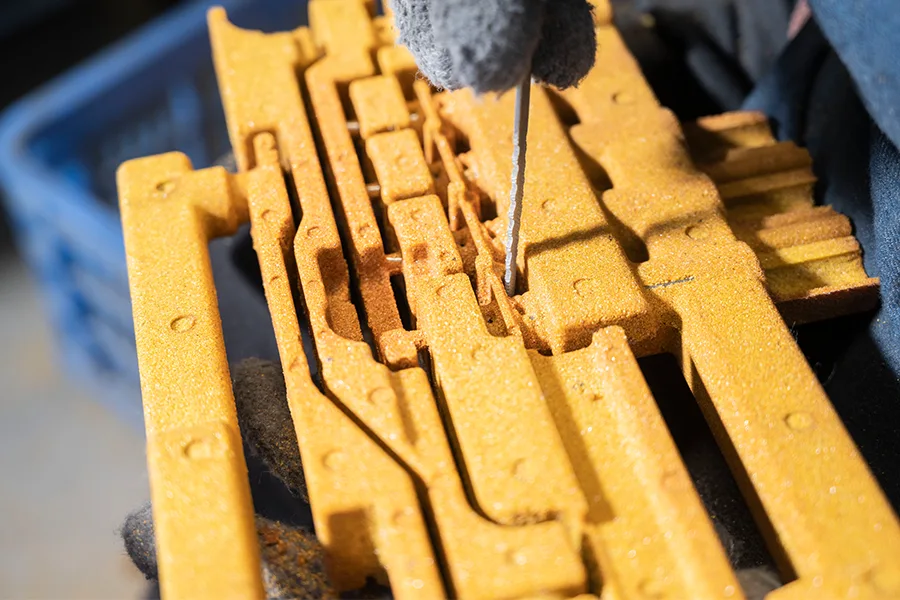
Stage 1: Raw Material and Brass Casting
Production begins with H59-1 DZR brass bar stock or ingots. The brass is melted at approximately 900–950°C and cast into faucet body blanks using gravity casting or low-pressure die casting. Gravity casting produces denser castings with fewer gas pores than die casting, which matters for pressure-bearing components like faucet bodies.
The casting temperature must be tightly controlled—overheating burns alloying elements (particularly the arsenic that provides dezincification resistance), while underheating creates cold shuts and misruns that weaken the body. A casting defect in a faucet body is a pressure failure waiting to happen: the high-pressure burst test during QC will expose internal porosity that the naked eye cannot see.
Stage 2: CNC Machining and Trimming
The cast blank moves to CNC machining centers for facing, drilling, and threading. CNC machining achieves dimensional tolerances of ±0.05 mm on critical interfaces—thread pitches, valve seats, and aerator mounting bores. These tolerances directly affect leak prevention: a valve seat that is 0.1 mm out of round will cause the ceramic cartridge to seat unevenly, leading to premature wear and dripping.
Manufacturers that machine faucet bodies on manual lathes cannot hold these tolerances consistently across a production batch. CNC machining also produces repeatable surface finishes on sealing surfaces, which is why CNC-equipped factories produce lower defect rates than manual-operation shops.
Stage 3: Polishing
The machined faucet body enters the polishing station where every surface is prepared for plating. Polishing at Watersino is performed by artisans with over 5 years of experience—this is not an arbitrary threshold. Polishing quality determines whether the plating layer adheres uniformly or develops pits and blisters after months of use.
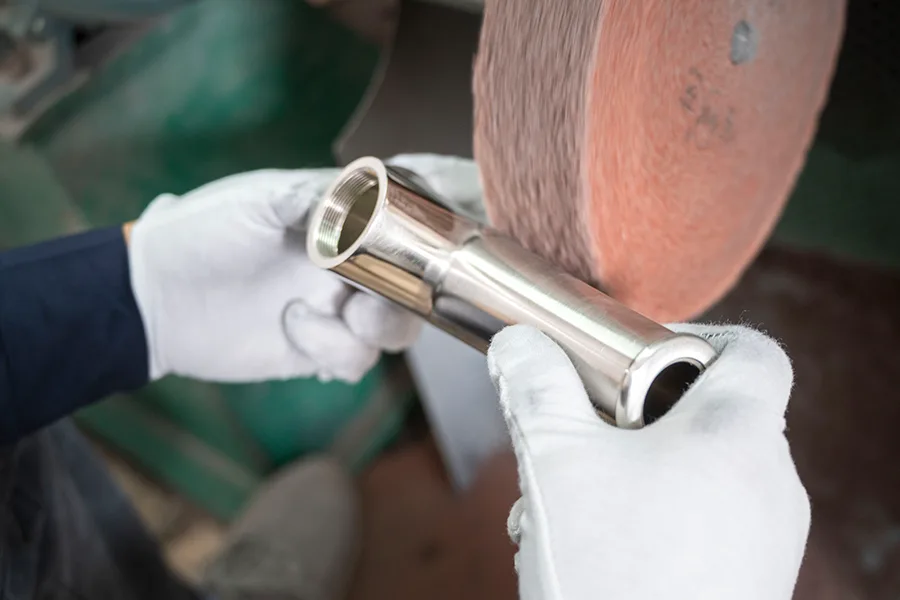
The polishing progression moves from coarse to fine: rough abrasive removes casting flash and machining marks, medium grit smooths the surface for plating adhesion, and fine grit creates the mirror finish that chrome and PVD layers require. Any scratch left by coarse grit will be magnified by the plating layer—what looks like a hairline mark before plating becomes a visible defect after.
Stage 4: Surface Treatment and Plating
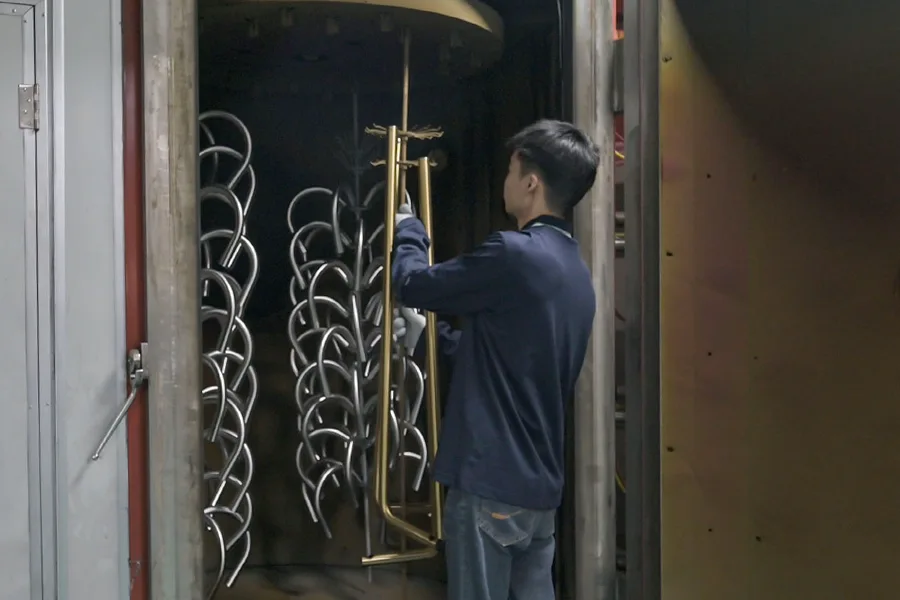
After polishing, the faucet body enters the plating chamber for surface treatment. The process differs by finish type and involves multiple steps that build up layers of protection and color. This stage is covered in detail in the next section.
Stage 5: Assembly with Premium Components
The finished faucet body moves to assembly where it receives its functional components: ceramic cartridge, aerator, hoses, handles, and escutcheons. Component selection at this stage determines whether the faucet will last 500,000 operating cycles or fail at 50,000.
Watersino sources cartridges from Kerox (Spain) and Citec (Hungary), aerators from Neoperl, hoses from Tucai (Spain), and thermostatic valves from Vernet (France). These are not commodity components—they represent the top tier of faucet industry suppliers, and their inclusion in a faucet is a quality signal that experienced buyers check for during supplier evaluation.
Stage 6: Final Inspection
Every assembled faucet undergoes individual inspection—including water pressure testing, functional cycling, and surface examination—before packaging. Inspectors wearing gloves check for scratches, fingerprints, plating defects, and handle alignment. Faucets that fail any check are reworked or quarantined.

Inside the Plating Chamber: Chrome vs Matte Black vs PVD
Surface treatment is where faucet manufacturers either invest in durability or cut corners. Three finish types dominate bathroom faucet production, each with a distinct process architecture that determines long-term performance.
Chrome: 3-Layer Water Plating
Chrome finish uses a water plating (electroplating) process with three distinct layers. The acid copper layer (6–12 μm) fills micro-scratches from polishing and creates a smooth substrate. The nickel layer (8–12 μm) provides the primary corrosion barrier—this is the layer that prevents brass from leaching through to the surface. The chrome layer (0.25–0.4 μm) delivers the final color, hardness, and chemical resistance.
Total chrome coating thickness reaches 14.25–24.4 μm. The nickel layer is the workhorse: a manufacturer that reduces nickel thickness to save plating time will produce faucets that look identical at the factory but develop corrosion spots within 12 months of installation. Verify plating thickness by requesting a coating thickness test report (X-ray fluorescence measurement) with each production batch.
Matte Black: 9-Step Water Plating
Matte black is the most complex water plating finish, requiring 9 process steps across three functional layers: acid copper base, blackening layer, and sealing glaze. The sealing glaze layer is critical—without proper sealing, the black finish rubs off on cleaning sponges and develops silver wear marks at handle contact points within 3–6 months of daily use.
The 9-step process includes pre-treatment (degreasing, acid activation), base layer deposition, blackening, multiple rinses, sealing glaze application, and final curing. Each step has temperature and chemical concentration parameters that must be controlled within narrow tolerances. A matte black finish that skips or rushes the sealing glaze step will look perfect out of the box but fail within months.
PVD: 8-Step Physical Vapor Deposition
PVD finishes—brushed gold, gunmetal grey, brushed nickel, rose gold—use an 8-step process with three composite layers: base material treatment, PVD color deposition, and sealing glaze. PVD deposits metal ions (typically titanium nitride or zirconium nitride) in a vacuum chamber, creating a molecular-level bond with the brass substrate that electroplating cannot achieve.
PVD coating provides superior scratch and tarnish resistance compared to electroplating. The vacuum deposition process produces no volatile organic compounds (VOCs) or hazardous byproducts, aligning with sustainable manufacturing requirements for European and North American markets. The trade-off is cost: PVD chamber setup is more expensive than electroplating baths, which means custom PVD colors typically require higher minimum order quantities.
Watersino develops new finish colors and styles monthly at its dedicated surface treatment lab, with a 7-step finish test protocol verifying adhesion, color stability, and chemical resistance before any new finish enters production.
| Beenden | Process | Steps | Durability Driver |
|---|---|---|---|
| Chrom | Water plating (3 layers) | — | Nickel layer 8–12 μm (corrosion barrier) |
| Mattschwarz | Water plating (3 layers) | 9 steps | Sealing glaze layer (wear resistance) |
| PVD (Gold, Grey) | Physikalische Gasphasenabscheidung | 8 steps | Molecular bond + sealing glaze |
Source Faucets with Verified Plating Thickness
Watersino produces 1,000+ certified bathroom faucet models with 20+ finish options, Kerox/Citec ceramic cartridges, and Watermark/cUPC/WRAS compliance. Request coating thickness reports and component certificates for your production batch.
Component Selection: Why Cartridge Brand Determines Lifespan
A faucet body can last 20 years, but if the cartridge fails at 50,000 cycles, the faucet is dead. The cartridge—the ceramic disc valve that controls water flow and temperature—is the highest-wear component in a bathroom faucet. Brand selection at this stage separates a faucet that outlasts its warranty from one that starts dripping within two years.
Watersino uses four cartridge suppliers, each selected for specific faucet types:
- Kerox (Spain): Smooth operation and water efficiency. The most popular ceramic cartridge brand for premium bathroom faucets, specified for single-handle mixers where precise temperature control matters.
- Citec (Hungary): Precise control and wide compatibility. Used where multi-mode operation or custom handle designs require a cartridge with broader mechanical tolerance ranges.
- Vernet (France): Thermostatic mixing valves for faucets that require precise temperature stability and limescale resistance. Specified for thermostatic shower mixers and safety faucets in commercial installations.
- Neoperl (aerators): Reduces splashing and maintains gentle water flow. Neoperl aerators are standard on premium faucets because they maintain flow patterns across varying water pressures.
Importers should ask their manufacturer which cartridge brand is specified for each faucet model. A manufacturer that cannot name the cartridge brand is sourcing from generic suppliers—these cartridges may work initially but lack the cycle life testing that branded cartridges undergo. The cost difference between a Kerox cartridge and a generic equivalent is small relative to the cost of a faucet failure in the field.
12 Quality Control Tests for Faucet Production
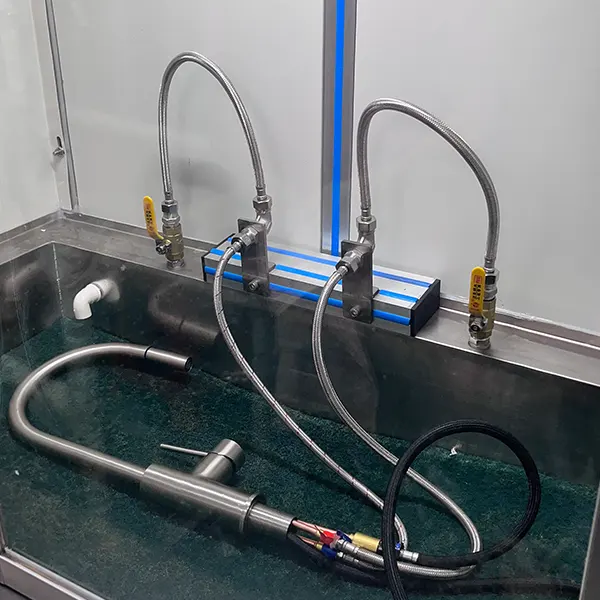
Quality control at a faucet manufacturer is a 12-test protocol that verifies both functionality and surface durability. These tests align with the certification requirements of Watermark, cUPC, WRAS, and CE, and are conducted under ISO 9001 compliance.
Functionality Tests (6)
- High-Pressure Burst Test: The faucet body is pressurized beyond normal operating pressure to verify structural integrity at the casting and machining interfaces. This test catches internal porosity and casting defects that would cause leaks under municipal water pressure.
- Swing Spout Life Test: Repeated back-and-forth cycling of swivel spouts (typically kitchen faucets) to verify the spout mechanism survives daily use over the stated lifespan.
- Switch Life Test: Handle and control mechanisms are cycled on and off to simulate years of daily operation—verifying the cartridge and handle interface survive beyond the warranty period.
- Shower Head Life Test: Extended pressure testing and usage simulation for shower faucet components.
- Pull-Out Life Test: Extendable pull-out sprayers are cycled through full extension range to test hose durability and retraction mechanism.
- Flow Rate Test: Water flow is measured at controlled pressure to verify compliance with WELS and WaterSense water efficiency requirements for certified markets.
Surface Tests (6)
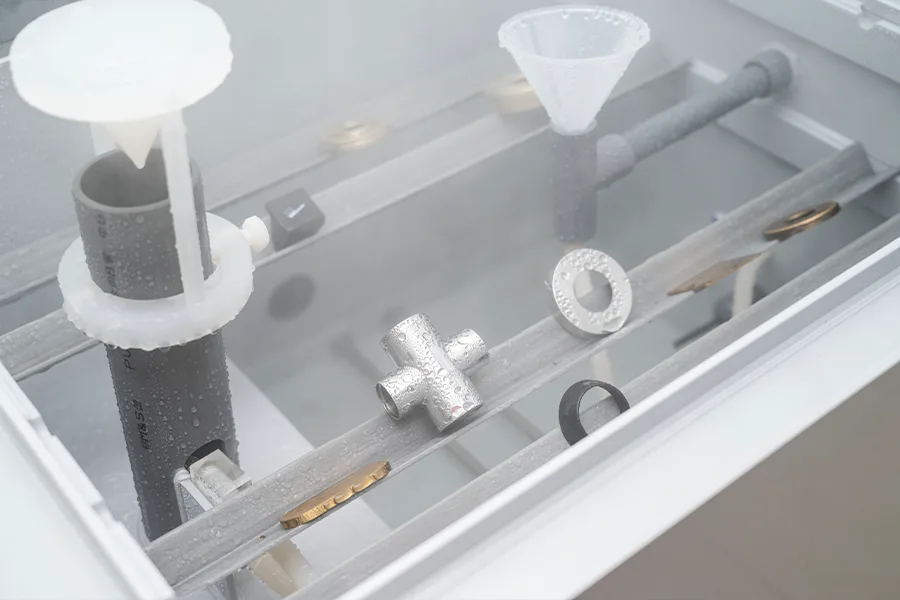
- Electroplating Salt Spray Test: The finish is subjected to salt spray chamber exposure to simulate years of corrosion. Non-negotiable for Watermark and cUPC certification—a faucet that fails cannot be sold in Australia, New Zealand, or North America.
- High-Temperature Test: The finish is exposed to elevated temperatures to verify it does not discolor or delaminate when exposed to hot water over the faucet’s service life.
- Abrasion Resistance Test: The surface undergoes mechanical abrasion cycles simulating scrubbing and cleaning. Finishes that wear through to bare metal will show wear marks in customer bathrooms within months.
- Color Test: Color consistency is measured across the faucet surface and between units in the same batch. Inconsistent color signals plating bath contamination or uneven PVD deposition.
- Water Flow Test: An automatic flow test machine verifies the aerator and internal channels deliver consistent water flow without channeling or pressure drops.
- Scratch-Free Test: Dedicated inspectors wearing gloves examine each individual faucet for surface scratches, fingerprints, or handling marks before packaging.
Certifications by Market for Bathroom Faucets
Certification requirements for bathroom faucets vary by destination market. Importers must verify SKU-level certifications—not just company-level ISO certificates. A company may hold ISO 9001 without every faucet model being Watermark-certified.
| Zertifizierung | Market | Key Requirement |
|---|---|---|
| Wasserzeichen | Australia / New Zealand | Mandatory for plumbing; required for plumber installation and insurance |
| WELS | Australia / New Zealand | Water efficiency rating (1–6 stars based on flow rate) |
| SAA | Australia / New Zealand | Electrical safety for sensor faucets and thermostatic mixing valves |
| cUPC | USA / Canada | Uniform Plumbing Code compliance for product sale |
| WaterSense | USA | EPA program; faucets meet water conservation standards without sacrificing function |
| WRAS | Vereinigtes Königreich | Prevents water supply contamination; critical for government and engineering projects |
| CE | European Union | Safety, health, and environmental compliance |
| ACS | Spain / EU | Tests materials for heavy metal leaching (lead, chromium, nickel) |
For the Australian market, Watermark certification creates a competitive barrier that benefits certified manufacturers. Watersino achieved Watermark and WELS certification during its 2013–2016 Australian market expansion, and these certifications remain a differentiator for importers sourcing faucets for Australia and New Zealand—the only faucets that can be legally installed by a licensed plumber in these markets carry the Watermark.
OEM vs Private Label: Manufacturing Implications
Brand owners choosing between OEM and private label production face different manufacturing implications. OEM production uses the manufacturer’s existing tooling and designs—the buyer selects from the catalog and applies their branding. Private label (or ODM) production requires custom tooling, new design development, and higher minimum order quantities.
OEM offers faster time-to-market (4–6 weeks vs 12–16 weeks for private label) and lower tooling costs (existing molds vs custom mold development). The trade-off is differentiation: OEM products may overlap with competitors using the same manufacturer. Private label provides exclusive designs and custom specifications but requires investment in tooling, prototyping, and certification testing for the new models.
For brands entering a new market, OEM production with custom finishes and logo branding is the recommended starting point. This approach provides OEM customization without private label tooling costs, allowing the brand to test market response before committing to exclusive molds. Custom PVD colors and logo etching are available at lower MOQs than full private label development.
FAQ: Bathroom Faucet Manufacturing
What brass grade is best for bathroom faucets?
H59-1 DZR (dezincification-resistant) brass is the industry standard for certified bathroom faucets. It resists zinc leaching in soft water and high-chloride environments, meets low-lead requirements for US, EU, and Australian markets, and provides natural antimicrobial properties. Common brass grades fail dezincification testing during WRAS and Watermark certification.
What is the difference between PVD and chrome plating for faucets?
Chrome plating uses electroplating with 3 layers: acid copper (6–12 μm), nickel (8–12 μm), and chrome (0.25–0.4 μm) in a wet chemical bath. PVD (Physical Vapor Deposition) deposits metal ions in a vacuum chamber across 8 steps and 3 composite layers, creating a molecular bond that outperforms electroplating for scratch resistance. PVD produces no VOCs, meeting environmental compliance for EU and North American markets.
Which ceramic cartridge brand should I specify for premium faucets?
Kerox (Spain) and Citec (Hungary) are the industry-standard ceramic cartridge brands for premium bathroom faucets. Kerox provides smooth operation and water efficiency for single-handle mixers. Citec offers wide compatibility for custom handle designs. For thermostatic mixers, Vernet (France) provides temperature stability and limescale resistance.
How thick should faucet plating be?
Chrome plating on bathroom faucets should total 14.25–24.4 μm across 3 layers: acid copper 6–12 μm, nickel 8–12 μm, and chrome 0.25–0.4 μm. The nickel layer is the primary corrosion barrier—reducing nickel thickness is the most common shortcut in budget plating. Request an X-ray fluorescence coating thickness report with each production batch.
What certifications do I need to import bathroom faucets?
Certification depends on your destination market: Watermark and WELS for Australia and New Zealand, cUPC for USA and Canada, WRAS for the United Kingdom, CE for the European Union, and ACS for Spain. For sensor faucets or thermostatic mixing valves in Australia, SAA electrical safety certification is also required. Verify SKU-level certificates for each faucet model.
How long does bathroom faucet production take?
Standard finish faucets with existing tooling typically take 25–35 days for production. Custom PVD finishes require additional chamber setup time, and private label mold development adds 2–4 weeks. Factor in 5–7 days for QC testing (12 tests) and packaging. Confirm lead times with your manufacturer and request a production schedule for bulk orders.
Abschluss
The manufacturing quality of a bathroom faucet is determined by five verifiable factors: H59-1 DZR brass for the body material, 3-layer chrome plating with adequate nickel thickness (8–12 μm), branded ceramic cartridges from Kerox or Citec, 12-test QC protocol including salt spray and burst testing, and SKU-level certifications for your target market. A manufacturer that provides specifics on each factor is equipped to deliver consistent quality; one that gives vague answers is not.
Importers’ action roadmap:
- Request a material composition report confirming H59-1 DZR brass (not common brass) for every faucet body.
- Demand X-ray fluorescence coating thickness reports showing nickel layer at 8–12 μm for chrome-plated faucets.
- Confirm cartridge brand (Kerox, Citec, or Vernet) is specified per faucet model—not generic equivalents.
- Verify the 12-test QC protocol includes salt spray, burst pressure, and life cycle testing under ISO 9001.
- Request SKU-level Watermark, cUPC, or WRAS certificates for the exact models you source.
- For new markets, start with OEM production and custom finishes before investing in private label tooling.
Watersino manufactures certified bathroom faucets from H59-1 DZR brass with 20+ finish options, premium component suppliers, and 19 years of production experience. For sourcing inquiries, contact the team to discuss specifications, certifications, and customization requirements.