Stainless Steel Sink Grades, Gauges & Construction: A B2B Buying Guide
Stainless steel sinks account for over 40% of the global kitchen sink market — and that share keeps growing. For distributors, contractors, and project specifiers, the purchasing decisions come down to three factors that directly affect margin, durability, and end-user satisfaction: steel grade, gauge thickness, and manufacturing method.
This guide breaks down each factor with verifiable specifications so your sales team can answer buyer questions with confidence and your procurement team can source the right product at the right price.
304 vs 316 Stainless Steel: Which Grade Specified?
The two stainless steel grades used in sink manufacturing are 304 (also called 18/8 or 18/10) and 316 (marine grade). The difference is metallurgical — and it matters for specific applications.
304 Stainless Steel (18/8)
- Composition: 18% chromium, 8% nickel
- Corrosion resistance: Handles household water, food acids, and standard cleaning chemicals
- Market position: The standard grade for residential and commercial kitchen sinks — approximately 90% of all stainless steel sinks produced globally use 304 grade
- Best applications: Residential kitchens, restaurants, light commercial spaces, standard contractor projects
316 Stainless Steel (Marine Grade)
- Composition: 16% chromium, 10% nickel, 2% molybdenum
- Corrosion resistance: The molybdenum addition provides resistance to chloride pitting — critical in saltwater and high-chloride environments
- Market position: Premium specification for demanding environments
- Best applications: Coastal properties, laboratories, hospitals, food processing plants, marine environments, chemical handling areas
Sourcing note: 316 sinks carry a 25–40% price premium over equivalent 304 models. For most B2B projects, 304 grade delivers the required performance. Specify 316 only when the environment demands chloride resistance — the cost is difficult to justify otherwise.
Gauge Thickness Explained: 16 vs 18 vs 20 Gauge
Gauge refers to the thickness of the stainless steel sheet. Lower gauge number = thicker steel. This is the single most common question from buyers evaluating product quality and pricing differences.
| Gauge | Thickness (mm) | Thickness (inches) | Typical Applications | Buyer Profile |
|---|---|---|---|---|
| 16 gauge | 1.52 mm | 0.0598″ | Heavy-duty residential, premium commercial, contractor-grade projects | Distributors targeting premium segment; contractors specifying for custom builds |
| 18 gauge | 1.22 mm | 0.0478″ | Standard residential and commercial — the market default | Volume distributors; general contractors; property developers |
| 20 gauge | 0.91 mm | 0.0359″ | Budget residential, rental properties, light-duty applications | Price-sensitive markets; high-volume low-margin programs |
What this means for your customers: A 16 gauge sink resists denting and oil-canning (that flexing sensation when pressing on the basin) far better than 20 gauge. The difference is immediately noticeable during use. Most mid-range and premium brands specify 18 gauge as their standard, with 16 gauge as their upgrade option.
Quick test for buyers: Press your thumb firmly against the basin floor. A 16 or 18 gauge sink will feel rigid. A 20 gauge sink will flex slightly. This simple check separates quality tiers faster than any spec sheet.
For a deeper look at how gauge and material choices compare across all sink types, see our guide on the best kitchen sink materials.
Stamped vs Handcrafted: Two Manufacturing Methods
The manufacturing process determines the sink’s structural characteristics, price point, and lead time. Both methods produce quality products — they serve different market segments.
Stamped (Drawn) Sinks
- Process: A hydraulic press stamps a single steel sheet into a basin shape under pressures exceeding 1,000 tons
- Corner radius: Typically 10–15mm (rounded corners) due to the drawing process
- Depth consistency: Uniform wall thickness throughout the basin
- Production speed: High — thousands of units per month per production line
- Price range: Lower; suitable for volume distribution
- MOQ: Typically 100–300 units per SKU
Handcrafted (Welded) Sinks
- Process: Separate steel sheets are cut, bent, and TIG-welded into a basin by skilled technicians
- Corner radius: As tight as 0–5mm (near-zero radius, square corners) — the visual signature of premium sinks
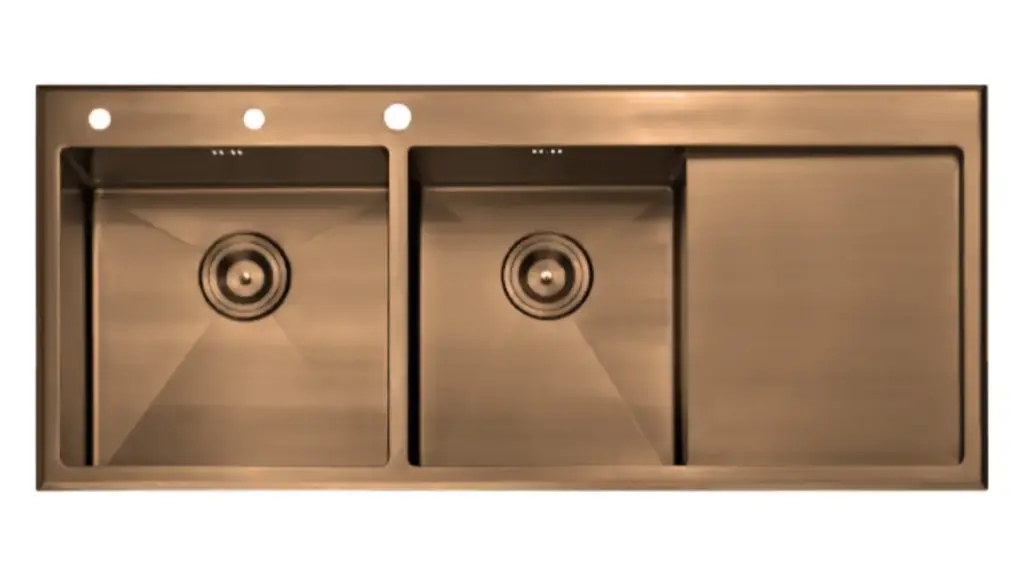
- Customization: Bowl configurations, drain placements, and accessories (cutting boards, colanders) can be customized per order
- Production speed: Lower — each sink requires 2–4 hours of skilled labor
- Price range: 2–4x the cost of stamped equivalents
- MOQ: Typically 30–50 units per SKU
B2B takeaway: Stamped sinks dominate the volume market and deliver consistent quality at scale. Handcrafted sinks serve the premium and project-specific segments where design differentiation and custom dimensions justify the higher cost. Many distributors stock both tiers to cover the full market.
Read more about how these processes work in detail in our article on the stainless steel sink manufacturing process.
Top-Mount vs Undermount Installation
| Fonctionnalité | Top-Mount (Drop-In) | Sous plan |
|---|---|---|
| Installation | Drops into countertop cutout; rim visible on top | Mounts beneath countertop; no visible rim |
| Countertop compatibility | All types including laminate and wood | Solid surface only (granite, quartz, marble) |
| Counter space | Rim reduces usable basin area slightly | Full cutout opening; easier to wipe debris into sink |
| Installation cost | Lower — DIY-friendly | Higher — requires professional countertop fabrication |
| Market preference | Rental properties, budget projects, replacement jobs | Premium residential, commercial projects, new construction |
For contractors and specifiers: Undermount has become the default specification in mid-range and above projects across North America and Europe. Top-mount remains relevant for replacement markets and budget-conscious developments. When specifying undermount, confirm the countertop fabricator can accommodate the sink weight — a double-bowl undermount in 16 gauge can exceed 25 kg.
Stainless Steel Sink Brand Landscape for B2B Buyers
The market breaks into three tiers based on brand positioning, quality consistency, and pricing structure:
Tier 1: Premium Brands (Retail $300–$800+)
Brands like Blanco, Franke, and Hafele dominate the premium specification market. They offer 16–18 gauge 304 stainless steel, handcrafted construction options, and strong brand recognition that supports higher retail margins. Lead times run 4–8 weeks for standard SKUs.
Tier 2: Mid-Range Brands (Retail $150–$350)
Brands like Ruvati, Kraus, Zline, and Horizon target the value-conscious buyer who still wants 18 gauge construction and quality finishing. These brands offer the best margin-to-quality ratio for distributors building a broad catalog.
Tier 3: Value / Private Label (Retail $50–$180)
OEM and ODM manufacturers — primarily based in China’s Guangdong and Zhejiang provinces — produce sinks for private label programs and high-volume distribution. Quality varies significantly between factories. Reputable manufacturers produce 304 grade sinks at 18 gauge that meet the same performance standards as Tier 2 branded products, at a fraction of the cost.
For a broader view of the competitive landscape, see our ranking of the top 10 kitchen sink brands.
Pricing Tiers at a Glance
| Tier | Gauge | Grade | Construction | FOB Price Range (Single Bowl) | Target Market |
|---|---|---|---|---|---|
| Premium | 16 gauge | 304 or 316 | Handcrafted | $80–$200 | Designer showrooms, luxury projects |
| Mid-Range | 18 gauge | 304 | Stamped or handcrafted | $35–$90 | Home centers, online retailers, contractors |
| Value | 20 gauge | 304 | Stamped | $15–$40 | Volume distributors, rental market, budget programs |
Note: FOB prices vary by order quantity, finish, and accessories. Prices above reflect standard single-bowl models with satin finish, quantities of 200+ units.
Maintenance & Quality Verification for B2B Buyers
Quality stainless steel sinks resist staining when the correct grade is specified for the environment. These practices help your customers maintain the product — and reduce warranty claims:
- Initial cleaning: Always clean in the direction of the grain (the visible brushing lines). Cross-grain cleaning lifts the finish.
- Water spots: Common in areas with hard water. A wipe-down after installation prevents mineral buildup. Recommend pH-neutral cleaners to end users.
- Surface scratches:Normal in the first 30 days of use as the satin finish settles. This is not a defect — educate customers during the handover phase.
- Chloride exposure: If a customer reports rust spots on a 304 sink, test the water for chloride levels. If above 200 ppm, a 316 upgrade is the correct specification.
- Warranty benchmark: Premium brands offer lifetime warranties; mid-range brands typically offer 10–25 years. When sourcing OEM, negotiate warranty terms that match your market expectations.
Frequently Asked Questions
What is the difference between 16 and 18 gauge stainless steel sinks?
16 gauge steel is 1.52mm thick; 18 gauge is 1.22mm thick. The 16 gauge sink resists denting and oil-canning better, making it the preferred choice for premium and commercial applications. 18 gauge is the standard for most residential installations and offers the best balance of durability and cost.
Is 304 or 316 stainless steel better for kitchen sinks?
For standard kitchen environments, 304 stainless steel is the correct choice — it handles food acids, household cleaners, and daily use without issue. 316 stainless steel is necessary only in high-chloride environments: coastal areas with salt air, commercial kitchens using heavy chlorine-based sanitizers, or laboratory settings. The 25–40% price premium of 316 is not justified for typical residential or restaurant use.
How do I tell if a sink is truly 304 stainless steel?
Two reliable methods: (1) Request the manufacturer’s material test certificate — reputable factories provide MTCs traceable to the steel coil batch. (2) Use a stainless steel testing solution (molybdenum test for 316, nickel test for 304) available from welding supply stores. A magnet test is unreliable — both 304 and 316 can be slightly magnetic after cold working during the stamping process.
Are handcrafted sinks better than stamped sinks?
“Better” depends on the application. Handcrafted sinks offer tighter corner radii, custom configurations, and a premium aesthetic — ideal for high-end residential and hospitality projects. Stamped sinks offer consistent quality, faster production, and lower cost — ideal for volume distribution and standard contractor projects. Both serve distinct market segments profitably.
What gauge sink do professional contractors typically specify?
18 gauge is the standard specification for most contractor projects — it provides adequate durability at a competitive price point. For premium custom homes, commercial kitchens, and high-traffic public facilities, contractors upgrade to 16 gauge. The specification often depends on the project’s price-per-unit budget and the expected usage intensity.
What is the typical lead time for bulk stainless steel sink orders?
Stamped sinks: 15–30 days for standard models in quantities of 200–500 units. Handcrafted sinks: 30–45 days due to the manual fabrication process. Custom configurations (non-standard dimensions, special drain placements, custom accessories) add 7–15 days. Always factor in 5–10 days for quality inspection and ocean freight documentation.
Source Stainless Steel Sinks from Watersino
Watersino manufactures 304 and 316 grade stainless steel sinks in 16, 18, and 20 gauge — both stamped and handcrafted construction. We serve distributors, contractors, and project buyers across North America, Europe, and the Middle East with:
- MOQs starting at 50 units per SKU for handcrafted lines
- OEM and private label programs with custom packaging and branding
- Material test certificates provided with every shipment
- Quality inspection reports per order (dimensional, surface finish, material verification)
Request a quote or product catalog: Contact our B2B sales team at [email protected] with your specifications (grade, gauge, construction type, dimensions, quantity). We respond with pricing within 48 hours.