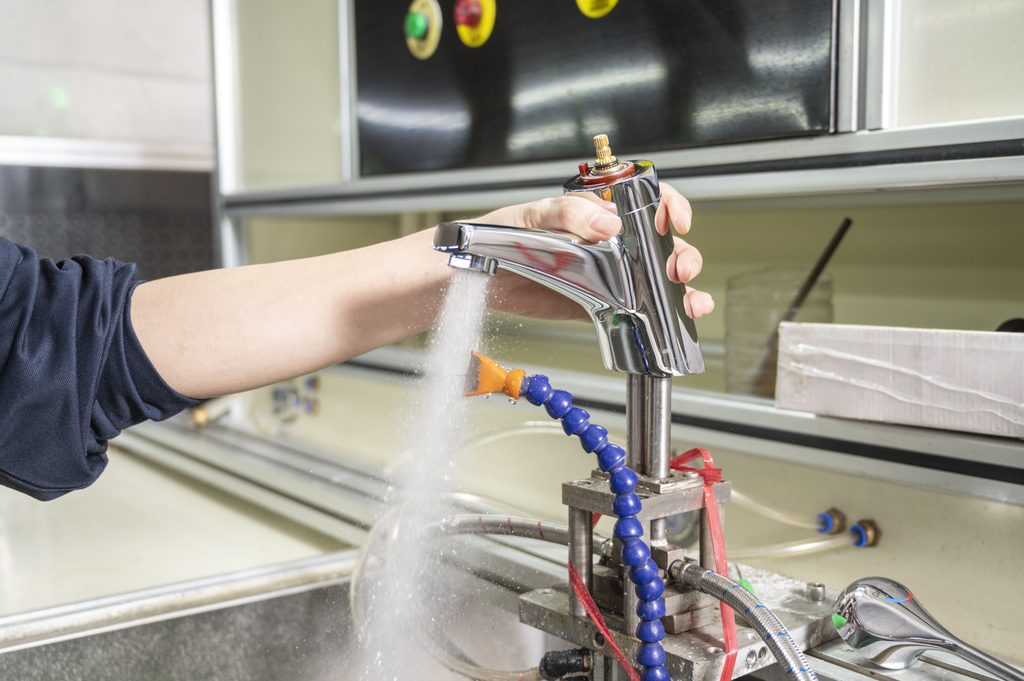
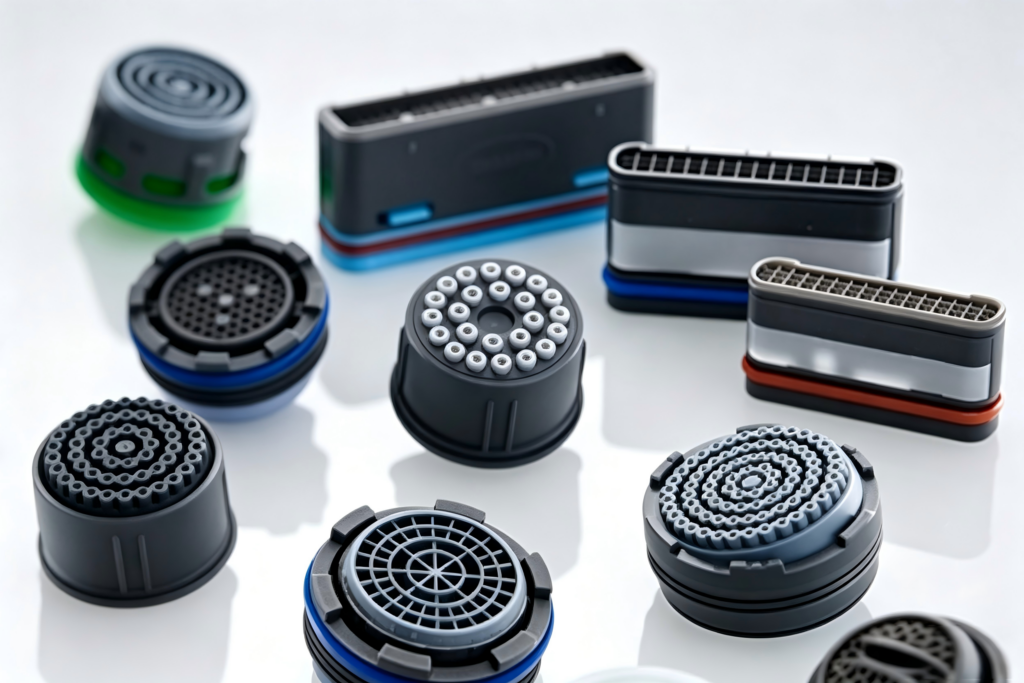
Importers who source stainless steel sinks from Chinese manufacturers often focus on price and delivery timelines while overlooking the manufacturing variables that determine whether a sink lasts 5 years or 25. The difference comes down to material grade, wall thickness, welding integrity, and surface treatment—four factors that separate a sink that passes Watermark or cUPC certification from one that rusts at the weld seams within months.
Watersino has manufactured stainless steel kitchen sinks under ISO 9001 compliance for 19 years, producing 800+ certified models across single-bowl, double-bowl, and drainboard configurations. This guide breaks down the 304 stainless steel sink manufacturing process step by step, explains the 12 quality control tests every batch must clear, and gives importers a concrete checklist for evaluating any stainless steel sink manufacturer before placing a bulk order.
Conclusiones clave
- SS304 is the baseline material for certified sinks—SS201 costs less but fails salt spray corrosion tests in marine and coastal markets.
- Chrome plating requires 3 layers totaling 14–24 μm: acid copper (6–12 μm), nickel (8–12 μm), and chrome (0.25–0.4 μm).
- Matte black finishes need 9 process steps including a sealing glaze layer; PVD finishes need 8 steps across 3 composite layers.
- Every sink batch undergoes 12 QC tests: 6 functionality tests (burst, flow rate, life cycles) and 6 surface tests (salt spray, abrasion, color, scratch, temperature, water flow).
- Certifications are market-specific: Watermark for Australia/NZ, cUPC for North America, WRAS for UK, CE for EU—verify SKU-level certificates, not just company-level.
Tabla de contenido
- Why 304 Stainless Steel Defines Sink Quality
- The Manufacturing Process Step by Step
- Surface Finishes: Chrome, PVD, and Brushed
- 12 Quality Control Tests Every Batch Must Pass
- Sink Configurations and Customization Options
- Certifications by Market: What Importers Need
- How to Evaluate a Stainless Steel Sink Manufacturer
- FAQ: Stainless Steel Sink Manufacturing
- Conclusión
Why 304 Stainless Steel Defines Sink Quality
The material grade in a stainless steel sink determines its corrosion resistance, structural integrity, and compliance with international plumbing standards. SS304—the grade used in Watersino’s kitchen sink production—contains 18% chromium and 8% nickel, which forms a passive oxide layer that self-heals when scratched. This layer is what prevents the rust pitting that destroys cheaper sinks in humid or coastal environments.
Some manufacturers substitute SS201 to cut raw material costs by roughly 15–20%. SS201 replaces nickel with manganese and nitrogen, which weakens corrosion resistance—particularly in chloride-rich environments like coastal Australia or regions with hard water. Sinks made from SS201 may pass a factory inspection but develop surface rust within 6–12 months of installation in humid climates. For importers targeting markets with Watermark or cUPC certification requirements, SS201 sinks typically fail the salt spray corrosion test during compliance audits.
SS316 offers superior corrosion resistance compared to SS304, with 2–3% molybdenum added for chloride environments. Marine applications and laboratory sinks sometimes specify SS316. For residential and commercial kitchen sinks, SS304 provides the optimal balance of performance and cost—SS316 adds approximately 25–40% to raw material cost without proportional lifespan gains in standard kitchen conditions.
| Property | SS201 | SS304 | SS316 |
|---|---|---|---|
| Chromium | 16–18% | 18–20% | 16–18% |
| Níquel | 3.5–5.5% | 8–10.5% | 10–14% |
| Molybdenum | None | None | 2–3% |
| Resistencia a la corrosión | Bajo | Alto | Excelente |
| Typical Use | Budget sinks | Certified kitchen sinks | Marine, lab, medical |
| Material Cost Index | ~80 | 100 (baseline) | 125–140 |
Verify material grade by requesting a mill test certificate (MTC) with each shipment. The MTC lists the heat number, chemical composition, and mechanical properties traceable to the original steel coil. A manufacturer that cannot provide MTCs for each batch is sourcing from unverified suppliers—a red flag for quality consistency.
The Stainless Steel Sink Manufacturing Process Step by Step
The production pipeline for a 304 stainless steel sink follows six sequential stages, each with specific quality checkpoints. Understanding these stages helps importers identify where defects originate and what questions to ask during a factory audit.
Raw Material Selection and Cutting
Production begins with SS304 cold-rolled steel coils. The coil is unrolled and cut into flat sheets sized for the sink model—typically 0.8–1.2 mm thickness for residential sinks and 1.2–1.5 mm for commercial-grade models. Thicker steel resists denting and thermal warping but increases material cost and requires higher-tonnage press equipment.
The cutting stage uses CNC-controlled shearing or laser cutting to achieve dimensional accuracy within ±0.5 mm. Precision at this stage matters because uneven blanks cause welding gaps and bowl distortion downstream. A manufacturer investing in laser cutting rather than manual shearing will produce tighter tolerances and fewer rejected blanks.

Forming and Deep Drawing
The flat steel blank is pressed into a bowl shape using hydraulic deep drawing presses. This is the most technically demanding stage—the press must apply 200–500 tons of force (depending on bowl depth and steel thickness) while controlling draw speed to prevent thinning at the bowl radius. Excessive draw speed stretches the steel beyond its formability limit, causing tearing at the corners.
Deep drawing happens in stages for sinks deeper than 200 mm. A first draw forms a shallow cup, and a second draw pushes the bowl to its final depth. The die and punch tooling must be polished to a mirror finish to prevent surface scoring on the drawn steel. Manufacturers using multi-stage drawing produce bowls with more consistent wall thickness than those using single-stage deep draw.
Welding and Corner Joining
For double-bowl and drainboard sinks, the drawn bowls are joined to the sink deck using TIG (tungsten inert gas) welding. TIG welding produces cleaner seams than MIG welding because it uses a non-consumable tungsten electrode with argon shielding gas, resulting in minimal spatter and a narrower heat-affected zone.
The critical welding parameter for sinks is heat input control. Excessive heat burns the chromium oxide layer, creating a discolored weld zone that becomes a corrosion initiation point. Skilled welders pulse the arc—on for 1–2 seconds, off for 0.5 seconds—to keep the heat-affected zone under 3 mm wide. After welding, the seam is ground flush and blend-polished until the joint is invisible to the eye and fingertip.
Polishing and Surface Treatment
The formed and welded sink body moves to the polishing station. Every artisan at this stage has over 5 years of experience polishing stainless steel—less experienced polishers leave visible swirl marks and uneven brush lines that show under raking light.
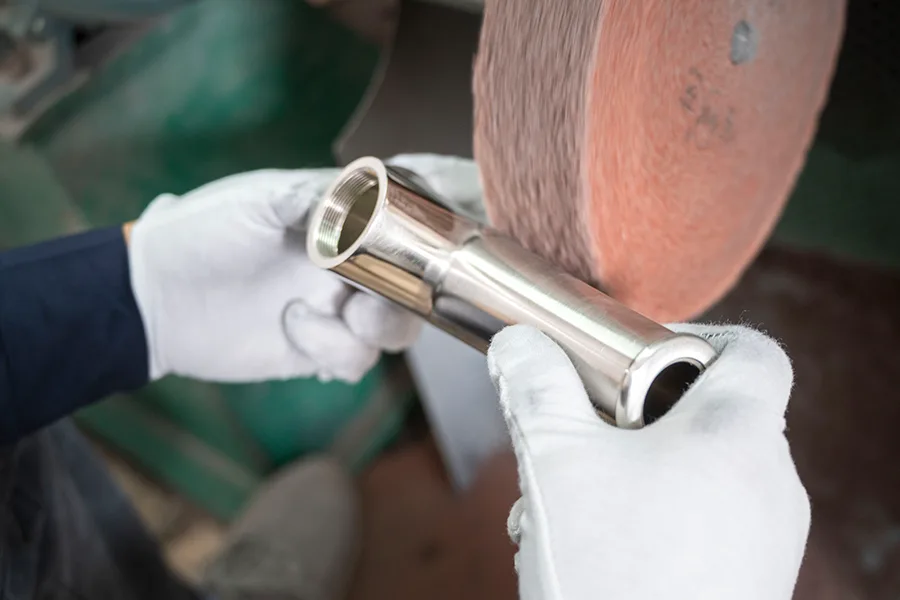
Polishing follows a multi-grit progression: coarse abrasive removes welding artifacts and drawing marks, medium grit establishes the brush line direction, and fine grit produces the final satin or mirror finish. The brush line must run in a single direction—typically front-to-back—across the entire bowl and deck. Inconsistent brush direction creates a mottled appearance that signals rushed workmanship.
For sinks receiving a colored finish (matte black, brushed gold, chrome), the polished surface undergoes additional coating processes described in the next section.
PVD Coating and Finishing
Sinks requiring colored finishes enter the plating or PVD chamber. The process differs by finish type:
Acabado cromado uses water plating with three layers: an acid copper layer (6–12 μm) fills micro-scratches from polishing, a nickel layer (8–12 μm) provides corrosion barrier and smoothness, and a chrome layer (0.25–0.4 μm) delivers the final color and hardness. Total coating thickness reaches 14.25–24.4 μm. The nickel layer does the heavy lifting for corrosion protection; a thinner nickel layer is the most common shortcut in budget plating.
Matte black finish uses a 9-step water plating process across three functional layers: acid copper base, blackening layer, and sealing glaze. The sealing glaze layer is what prevents the black finish from rubbing off on sponges and cleaning chemicals. Without proper sealing, matte black sinks develop silver wear marks within 3–6 months of daily use.
Acabados PVD (brushed gold, gunmetal grey, brushed nickel) use an 8-step process with three composite layers: base material treatment, PVD color deposition, and sealing glaze. PVD (Physical Vapor Deposition) deposits metal ions in a vacuum chamber, creating a bond at the molecular level that outperforms electroplating for scratch and tarnish resistance. PVD produces no VOCs or hazardous byproducts, aligning with sustainable manufacturing requirements for European and North American markets.

Assembly and Accessories
After finishing, the sink body receives its functional components: drain fittings, overflow assemblies, mounting hardware, and sound-deadening pads. The drain fitting must match the sink’s bowl configuration—single-bowl sinks typically use a 3.5-inch drain, while double-bowl sinks may use two drains or a shared waste system.
Sound-deadening pads are applied to the underside of the bowl to reduce water impact noise. These pads also provide thermal insulation that slows heat loss from dishwater. Premium sinks use full-coverage pads on the entire underside, while budget sinks use partial pads or spray-on undercoating. The difference is audible—full-coverage pads reduce noise by 8–12 decibels compared to bare steel.
Final Inspection and Packaging
Every sink undergoes individual inspection before packaging. Inspectors wearing gloves check for surface defects—scratches, fingerprints, weld discoloration, brush line inconsistencies—and verify dimensional accuracy against the product drawing. Sinks that fail any check are reworked or quarantined. Accepted sinks are foam-packed and carton-sealed for shipping.
Surface Finishes: Chrome, PVD, and Brushed
The surface finish on a stainless steel sink serves two functions: aesthetic appeal and functional durability. A finish that looks identical at the factory can perform drastically differently after 12 months of daily use. Importers should understand the coating architecture behind each finish type to evaluate whether a manufacturer’s finish will hold up in the target market.
| Tipo de acabado | Process | Steps | Key Layers |
|---|---|---|---|
| Cromo | Water plating | 3 layers | Copper 6–12 μm / Nickel 8–12 μm / Chrome 0.25–0.4 μm |
| Negro mate | Water plating | 9 steps | Acid copper / Blackening / Sealing glaze |
| PVD (Gold, Grey) | Deposición física de vapor | 8 steps | Base treatment / PVD color / Sealing glaze |
The finishes available span over 20 color options including chrome, brushed nickel, matte black, gold, rose gold, and titanium gold. Color and style development occurs monthly at the surface treatment lab, allowing brand owners to request custom shades for private label projects. A dedicated R&D team tests new finishes for adhesion, color stability, and chemical resistance before releasing them for production.
12 Quality Control Tests Every Batch Must Pass
Quality control at a stainless steel sink manufacturer is not a single inspection point—it is a 12-test protocol split into two categories: functionality tests that verify the sink performs under real-world conditions, and surface tests that verify the finish survives daily wear. These tests are conducted under ISO 9001 compliance and align with the certification requirements of target markets.
Functionality Tests (6)
- High-Pressure Burst Test: The sink body is pressurized with water beyond normal operating pressure to verify structural integrity at weld seams and bowl radii. This test catches welding defects that would cause leaks under municipal water pressure spikes.
- Flow Rate Test: Water flow is measured at a controlled pressure to verify the drain and overflow system handles the maximum expected flow rate without backing up. This matters for markets with WELS water efficiency ratings.
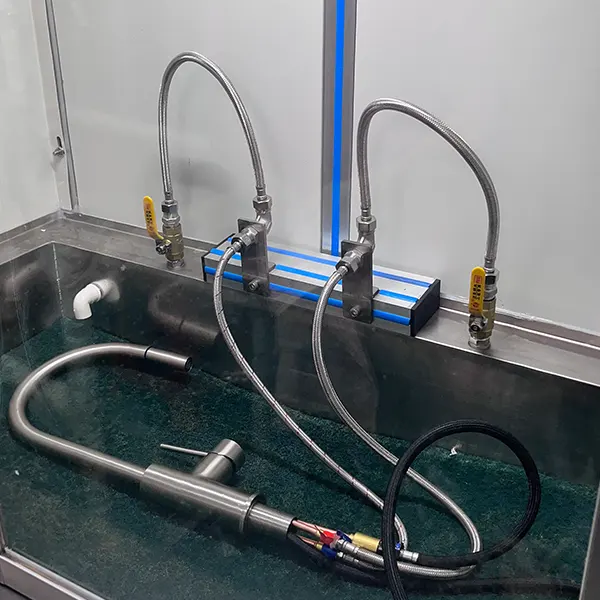
- Swing Spout Life Test: For sinks with integrated faucet spouts, repeated back-and-forth cycling verifies the spout mechanism survives daily use. This test applies primarily to kitchen sinks with pull-out sprayers.
- Switch Life Test: Handle and control mechanisms are cycled on and off to simulate years of daily operation. This test applies to sinks with integrated water controls.
- Shower Head Life Test: For sink-adjacent shower components, pressure testing over extended cycles validates long-term functionality.
- Pull-Out Life Test: Extendable pull-out sprayers are cycled through their full extension range repeatedly to test hose durability and retraction mechanism.
Surface Tests (6)
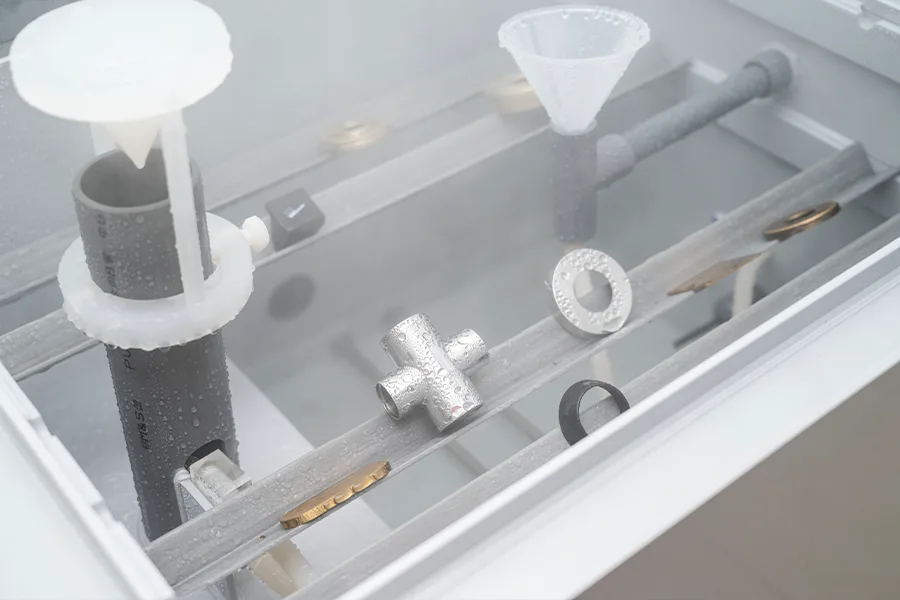
- Electroplating Salt Spray Test: The finish is subjected to a salt spray chamber environment to simulate years of corrosion exposure. This test is non-negotiable for Watermark and cUPC certification—a sink that fails salt spray cannot be certified for sale in Australia, New Zealand, or North America.
- High-Temperature Test: The finish is exposed to elevated temperatures to verify it does not discolor, blister, or delaminate when exposed to hot water and cookware. Sinks that receive hot pans directly must pass this test without finish degradation.
- Abrasion Resistance Test: The surface is subjected to mechanical abrasion cycles to simulate scrubbing, dish placement, and utensil contact. Finishes that wear through to bare metal during this test will show wear marks in customer kitchens within months.
- Color Test: Color consistency is measured across the sink surface and between units in the same batch. Inconsistent color signals plating bath contamination or uneven PVD deposition.
- Water Flow Test: An automatic flow test machine verifies water drains properly from all bowl configurations without pooling or retention in corners.
- Scratch-Free Test: Dedicated inspectors wearing gloves examine each individual sink for surface scratches, fingerprints, or handling marks. Any defect triggers rework before packaging.
Need Certified SS304 Sinks for Your Market?
Watersino produces 800+ certified sink and faucet models with Watermark, cUPC, WRAS, and CE compliance. Custom finishes, bowl configurations, and logo branding available for B2B orders.
Sink Configurations and Customization Options
B2B buyers can customize sinks across four dimensions: bowl configuration, mount type, surface finish, and brand identity. Understanding the production implications of each option helps importers avoid configurations that increase lead time or compromise quality.
Bowl Configurations
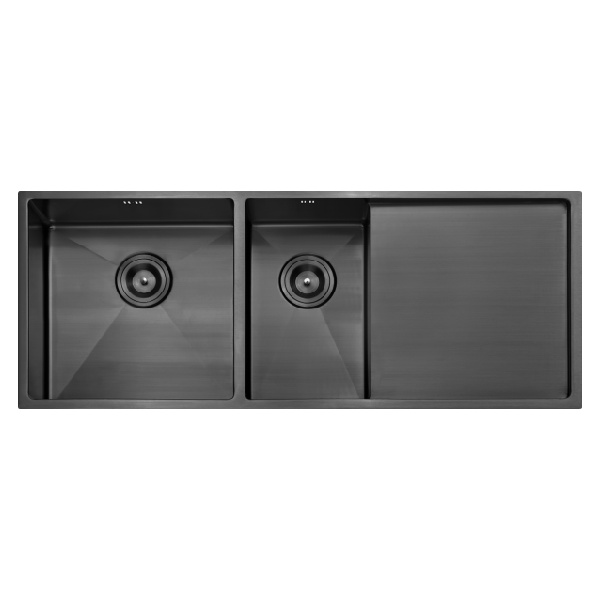
Single-bowl sinks offer the largest continuous workspace—ideal for commercial kitchens and large pot washing. The simpler geometry means fewer weld seams, reducing both manufacturing time and leak risk. Double-bowl sinks separate washing and rinsing tasks but require a center divider weld that must be ground and polished flush. Plus-bowl configurations add a small prep sink alongside the main bowl, which requires a third drawing die and additional welding.
Drainboard sinks integrate a sloped drainage surface adjacent to the bowl. The drainboard requires precise angle control during forming—too flat and water pools, too steep and the surface looks warped. Manufacturers with CNC-controlled press brakes produce more consistent drainboard angles than those using manual bending.
Mount Types
The three primary mount types—undermount, topmount, and counter-mount—differ in how the sink rim interfaces with the countertop. Undermount sinks require the most precise rim flatness because the rim is bonded beneath the counter edge; any warp creates a gap that traps debris. Topmount sinks are more forgiving because the rim sits on top of the counter with a visible edge. Counter-mount (flush-mount) sinks require the rim to match the counter thickness exactly, which demands tighter dimensional tolerances during forming.
Customization for Brand Owners
Brand owners can customize sink style, functional configuration, surface finish (20+ options), and logo branding. Custom logo application typically uses laser etching on the sink deck or embossing during the forming stage. Custom finishes require a minimum order quantity to justify the PVD chamber setup—the 8-step PVD process is not economical for small batches. For brands testing a new market, standard finishes (brushed nickel, chrome, matte black) offer the fastest lead times.
Certifications by Market: What Importers Need
Certification requirements for stainless steel sinks vary by destination market. Importers must verify that their manufacturer holds active, SKU-level certifications—not just company-level management system certificates. A company may hold ISO 9001 without every sink model being Watermark-certified.
| Proceso de dar un título | Market | Alcance |
|---|---|---|
| Filigrana | Australia / New Zealand | Mandatory for plumbing products; required for plumber installation and insurance |
| WELS | Australia / New Zealand | Water efficiency rating (1–6 stars based on flow rate) |
| cUPC | USA / Canada | Uniform Plumbing Code compliance for product sale |
| WaterSense | EE.UU | EPA program for water-efficient products |
| WRAS | Reino Unido | Prevents water supply contamination; critical for government projects |
| CE | European Union | Safety, health, and environmental compliance |
| ACS | Spain / EU | Drinking water contact material safety (heavy metal leaching) |
For the Australian market specifically, Watermark certification creates a natural barrier to entry that benefits certified manufacturers. A buyer specifying Watermark-certified sinks automatically filters out suppliers who cut corners on salt spray testing and material compliance. This is why Watersino’s investment in Watermark and WELS certification—achieved during the 2013–2016 Australian market expansion—remains a competitive advantage for importers sourcing for Australia and New Zealand.
How to Evaluate a Stainless Steel Sink Manufacturer
Evaluating a sink manufacturer requires going beyond factory photos and price lists. The following checklist covers the questions that separate a reliable long-term supplier from one that delivers inconsistent quality after the first order.
Material Verification
Request a mill test certificate (MTC) for every shipment. The MTC must show the heat number, chemical composition (confirming 18% chromium and 8% nickel for SS304), and mechanical properties. If a supplier cannot provide MTCs, they are buying from unverified coil distributors who may mix grades. Also ask whether they use cold-rolled or hot-rolled steel—cold-rolled produces a smoother surface finish and tighter dimensional tolerances.
Manufacturing Capability Audit
Ask these specific questions during a factory audit or video tour: What is the tonnage of their deep drawing press? Do they use single-stage or multi-stage drawing? Do they TIG weld or MIG weld? What grit progression do they use for polishing? Manufacturers with CNC laser cutting, multi-stage drawing, TIG welding, and structured polishing protocols produce tighter tolerances than those using manual equipment.
Quality Control Infrastructure
Verify that the manufacturer has dedicated QC testing equipment—not just visual inspection. Specifically, confirm they have a salt spray test chamber, a pressure test rig, and an abrasion tester. A manufacturer with 12 named QC tests and dedicated testing equipment has invested in quality infrastructure. One that relies on “visual inspection only” will miss defects that surface after installation.
Certification Depth
Ask for SKU-level certificates, not just company-level ISO certificates. A manufacturer should be able to provide the specific Watermark, cUPC, or WRAS certificate number for the exact sink model you are sourcing. If only the company holds ISO 9001 but individual products lack market-specific certification, you will bear the cost and risk of obtaining certification yourself.
Customization and MOQ
For brand owners, ask whether the manufacturer supports custom logo etching, custom finishes, and custom bowl configurations. Custom PVD colors typically require higher minimum order quantities due to chamber setup costs. If the manufacturer offers 20+ finishes and monthly color development, they have the R&D infrastructure for private label programs.
FAQ: Stainless Steel Sink Manufacturing
What is the best stainless steel grade for kitchen sinks?
SS304 is the industry standard for certified kitchen sinks. It contains 18% chromium and 8% nickel, providing the corrosion resistance needed to pass salt spray tests for Watermark and cUPC certification. SS316 offers superior chloride resistance for marine environments but costs 25–40% more without proportional lifespan gains in standard kitchen conditions.
How thick should a stainless steel sink be?
Residential kitchen sinks typically use 0.8–1.2 mm thick SS304 steel. Commercial-grade sinks use 1.2–1.5 mm for added dent resistance. Thicker steel improves durability and sound dampening but increases material cost and requires higher-tonnage press equipment during deep drawing.
What is the difference between PVD and electroplating for sinks?
PVD (Physical Vapor Deposition) deposits metal ions in a vacuum chamber, creating a molecular-level bond that outperforms electroplating for scratch and tarnish resistance. PVD uses 3 composite layers across 8 process steps. Electroplating (chrome) uses 3 layers—acid copper, nickel, and chrome—in a wet chemical bath. PVD produces no VOCs, making it suitable for markets with environmental compliance requirements.
Which certifications do I need to import stainless steel sinks?
Certification depends on your destination market: Watermark and WELS for Australia and New Zealand, cUPC for USA and Canada, WRAS for the United Kingdom, CE for the European Union, and ACS for Spain. Verify that your manufacturer provides SKU-level certificates for each sink model, not just company-level management system certificates.
How long does stainless steel sink manufacturing take?
Production time depends on order complexity and customization level. Standard finish sinks with existing tooling typically take 25–35 days for production. Custom PVD finishes require additional chamber setup time, and new mold development adds 2–4 weeks. Confirm lead times with your manufacturer and factor in 5–7 days for QC testing and packaging.
Can I get custom logo branding on stainless steel sinks?
Yes. Manufacturers like Watersino support custom logo branding through laser etching on the sink deck or embossing during the forming stage. Custom finishes and branding typically require minimum order quantities to justify PVD chamber setup and tooling adjustments. Standard finishes offer faster lead times for brands testing new markets.
Conclusión
Sourcing stainless steel sinks that pass international certification and satisfy end customers comes down to four verification points: confirm SS304 material with mill test certificates, audit the manufacturing process for multi-stage drawing and TIG welding, verify the 12-test QC protocol includes salt spray and burst testing, and request SKU-level certifications for your target market. A manufacturer that cannot answer these questions with specifics is not equipped to deliver consistent quality across orders.
Decision checklist for importers:
- Material: Request MTCs confirming 18% chromium, 8% nickel (SS304) for every shipment.
- Process: Confirm CNC laser cutting, multi-stage deep drawing, TIG welding, and multi-grit polishing.
- Finishes: Verify chrome plating has 3 layers (14–24 μm total), matte black has 9-step process with sealing glaze, PVD has 8-step 3-layer composite.
- QC: Confirm 12 tests including salt spray, burst, abrasion, and individual scratch inspection.
- Certifications: Request SKU-level Watermark, cUPC, WRAS, or CE certificates for the exact models you source.
Watersino manufactures SS304 kitchen sinks under ISO 9001 compliance with 800+ certified models and 19 years of production experience. For sourcing inquiries, contact the team to discuss your market requirements and certification needs.